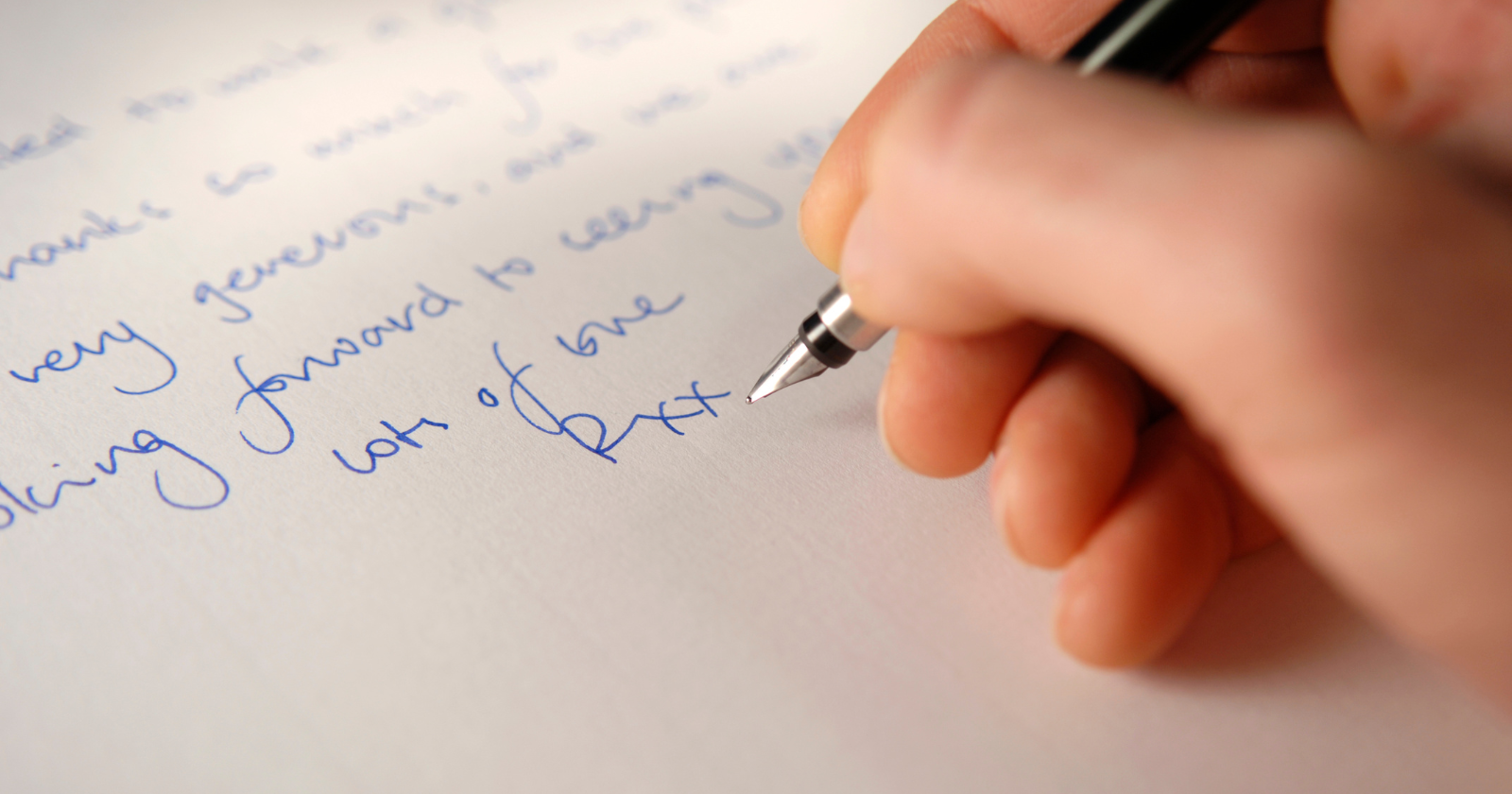
At some point, most people who kept journals as teenagers stopped. Not deliberately. The paper just got replaced by a notes app, a laptop, a phone. It happened quietly, the way most shifts do, without a moment where you decide.
I notice this in myself: I write constantly and yet my handwriting has become something I mostly save for grocery lists and seminar notes when I’ve forgotten my laptop. The irony is not lost on me.
What I’ve come to believe, partly from the research and partly from noticing how differently I think when I write by hand, is that the switch from pen to screen wasn’t just a change in medium. It was a change in how the brain processes what we’re doing. And that difference matters more than most of us have been told.
What the brain actually does when you write by hand
Typing and handwriting might both produce text, but they engage the brain through very different routes.
When you type, you press keys. Each key requires roughly the same movement: a downward tap, repeated across thousands of identical surfaces. The motion is minimal and repetitive. The brain processes the target (a letter, a word) and issues a simple motor command. The feedback loop is narrow.
Handwriting is something else entirely. Each letter requires a specific, learned sequence of fine motor movements. The hand has to produce the shape from scratch each time. This engages multiple brain systems simultaneously: the visual cortex (tracking what you’re producing), the motor cortex (executing the movements), somatosensory regions (processing feedback from the pen and the page), and areas involved in spatial reasoning and memory encoding.
A 2023 study published in Frontiers in Psychology, using high-density EEG with 256 sensors, recorded the brain activity of university students while they either handwrote or typed words they had been shown. The results were striking. When writing by hand, brain connectivity patterns were far more elaborate than during typing. Handwriting activated widespread neural networks; typing activated comparatively narrow ones.
The difference isn’t just quantitative. It’s qualitative. The kind of processing that handwriting triggers is the kind associated with encoding, retention, and deep learning.
Why motor involvement changes what you remember
There’s a concept in neuroscience sometimes called “embodied cognition.” The basic idea is that thinking isn’t a purely mental event that happens above the neck. Cognition is shaped by the body’s involvement in a task. How you physically engage with information changes how that information is stored and retrieved.
Handwriting is a case where this shows up clearly. The fine motor sequence involved in forming a letter creates a kind of multi-sensory imprint. You’re not just processing a symbol; you’re producing it with your hand, watching it emerge, feeling the resistance of the page. All of that adds up to richer encoding.
An earlier study in Frontiers in Psychology, using EEG in both children and young adults, found that cursive handwriting in particular engaged more of the brain than typewriting, and that the regions activated were associated with memory and learning. The researchers concluded that handwriting produces “deeper encoding” than typing, in a neurological sense, not just a metaphorical one.
What typing loses, then, isn’t effort for its own sake. It’s the richness of the signal the brain receives.
The note-taking question is more complicated than it looks
The practical case for handwriting usually comes up in the context of note-taking. And it’s often misunderstood.
People assume handwriting is better for memory because it’s slower, forcing you to summarize. This explanation is partial but incomplete. The slower pace does matter: you can’t transcribe everything when you write by hand, so you’re forced to process and select in real time. But the benefit isn’t only strategic.
Even when you control for transcription versus summarizing, studies suggest that the physical act of writing by hand produces a different quality of learning than typing. The mechanism isn’t just about cognitive effort. It’s about what the motor system contributes to memory consolidation.
There’s also something worth noting about the nature of digital note-taking. Typing on a screen is rarely just typing. There’s a tab open, a notification badge, an app wanting attention. The environment around the keyboard tends to pull cognition in multiple directions at once. The notebook doesn’t ping you.
This isn’t a romantic point about paper. It’s a cognitive one. The fewer competing stimuli, the more resources the brain can dedicate to the task at hand.
Where the common argument gets misleading
Not everything in the “handwriting is better” conversation holds up under scrutiny.
First, much of the research is done with children or students in formal learning settings. Whether the advantages hold equally for adults writing in different contexts, say, personal journaling, professional note-taking, or creative drafting, isn’t fully established. The neural benefits of handwriting may be strongest when you’re encoding new or complex information, not when you’re drafting something you already understand.
Second, there’s a fluency question. For people who type significantly faster than they write, the cognitive friction of slow handwriting might sometimes work against them. If the motor task itself becomes frustrating or attention-consuming, it could offset whatever benefits come from richer encoding.
Third, retrieval matters too. A handwritten notebook is harder to search, harder to share, harder to reference across documents. For some kinds of thinking work, the ability to link, search, and reorganize digital notes may outweigh the encoding advantages of handwriting. These are genuine trade-offs, not a clean win for either medium.
What the neuroscience actually supports is narrower but still meaningful: for learning and memory specifically, for tasks requiring deep processing rather than speed, handwriting activates more of the brain and tends to produce better retention. That’s a real finding. It doesn’t need to be overstated to be worth taking seriously.
What screens do to the process of thinking on paper
Here’s something I’ve noticed as both a researcher and a writer: the kind of thinking I do on paper is genuinely different from the kind I do on a screen. Not better, necessarily. Different.
On paper, the writing is harder to edit. That limitation turns out to be a kind of freedom. Because I can’t quickly rearrange everything, I tend to think longer before committing a sentence to the page. The friction creates presence.
On a screen, the writing is endlessly revisable. That’s an advantage for editing. But it can also create a kind of cognitive hovering: you never quite commit to a direction because everything can always be changed. The cursor blinks and so does your attention.
This isn’t a neurological claim. It’s an observational one. But it connects to what the research suggests about handwriting and the depth of engagement it requires. When more of the brain is involved, the experience of thinking changes too.
The environment question
Neuroscience increasingly shows that cognition is shaped by context, not just by what the brain does in isolation. The environment you’re writing in, its stimuli, its distractions, its affordances, shapes what your attention does.
Typing exists in the same environment as everything else on a screen. Every keyboard is adjacent to social media, email, news, open tabs. The handwriting surface typically isn’t. Even if you choose not to check those things, the brain has to work harder to ignore them. Attention is finite. The more it spends on suppression, the less it has for encoding.
This is part of what makes the comparison between handwriting and typing complicated. You’re not just comparing two input methods. You’re often comparing two completely different attentional environments.
For students, researchers, or anyone doing cognitively demanding work, the question isn’t only “which produces better learning?” It’s “what kind of environment supports the kind of thinking I want to do?”
Sovereign Mind lens
This question about handwriting and screens fits into a broader conversation about how we structure our attention and our learning. The Sovereign Mind framework offers a useful way to think about it.
- Unlearning: The inherited assumption is that newer tools are simply better, and that convenience is always a net positive. The research here suggests that’s worth questioning, especially when the “easier” option removes the kinds of challenge that drive deeper processing.
- Restoration: Handwriting is, among other things, a practice of sustained, undistracted attention. It activates the motor system, the visual system, and the memory systems together, which is a form of cognitive exercise that screen-based work often doesn’t provide. Returning to it, even occasionally, restores something in the quality of attention.
- Defense: Screens are not neutral tools. They exist within environments engineered for engagement and distraction. Choosing handwriting for certain tasks is partly a choice about which attentional environment you want to be in, and that’s a protective decision as much as a cognitive one.
When handwriting still makes sense
This isn’t a call to give up keyboards. For most writing tasks, typing is faster, more flexible, and more practical. I write these articles on a screen.
But there are contexts where handwriting may still have a real edge.
Learning genuinely new material: when the goal is encoding and retention, the richer neural activation of handwriting likely helps. A lecture, a difficult book, a new conceptual framework.
Thinking through something unresolved: the slower pace of handwriting, and its resistance to easy editing, can push clearer, more committed thinking. When I’m trying to work out something I don’t yet understand, paper is usually where I go.
Anything where distraction is the main obstacle: if you know that opening a laptop also means opening everything else, handwriting removes the problem at the source.
Journaling, specifically: there’s something about the private, physical quality of handwritten notes that changes how you write about your own experience. Whether that’s neurological or psychological is probably hard to separate.