Editor’s note: This article was updated in August 2026 to ensure accuracy and relevance in line with Ideapod’s editorial standards.
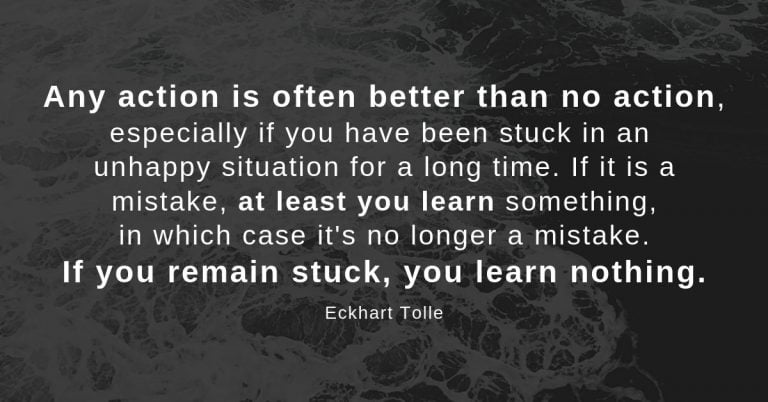
Eckhart Tolle’s sentences travel well. They get cropped onto sunset photos, printed on mugs, and passed around as if a single line could rearrange a life. Something about the compression makes them feel finished, complete, ready to be admired and then set down.
That admiration is where most people stop. A quote gets a moment of recognition, a small internal nod, and then the day resumes exactly as it was. The words were pleasant. Nothing moved.
This piece takes a different approach. Rather than stacking fifty lines for scrolling, it looks closely at a handful of Tolle’s recurring ideas and asks what each one is actually requesting of the person reading it. Because most of his best-known lines are not observations. They are instructions in disguise.
The quote as decoration versus the quote as demand
Consider one of Tolle’s most repeated ideas. In The Power of Now, he writes: “If you find your here and now intolerable and it makes you unhappy, you have three options: remove yourself from the situation, change it, or accept it totally.” It sounds gentle. Read carefully, it is not.
The line closes an escape route. It removes the comfortable middle ground where a person can feel dissatisfied, rehearse the dissatisfaction internally, and count that rehearsal as effort. Tolle’s point is blunt: mental activity about a problem is often a substitute for acting on it, not a step toward acting.
This is why quotes go inert. Turned into decoration, the demand gets filed away as inspiration. The reader feels briefly seen and does nothing. The words meant to interrupt a pattern become part of it.
Presence is not a mood, it is a place to stand
The idea Tolle is best known for is presence, or attention to the current moment rather than the mental commentary running alongside it. Popular culture tends to soften this into a feeling: calm, serene, vaguely blissful.
That reading misses the mechanism. Presence, in Tolle’s framing, is not an emotional state to chase. It is a shift in where attention rests. Instead of living inside a stream of predictions and replays, a person notices the actual room, the actual breath, the actual task in front of them.
The distinction matters because moods cannot be summoned on command, but attention can be redirected. Mindfulness practice, as described in the clinical literature, works along similar lines: the core skill is noticing where the mind has wandered and returning attention to the present, repeatedly, rather than chasing a particular emotional state. The American Psychological Association defines mindfulness simply as awareness of one’s internal states and surroundings, which is closer to Tolle’s meaning than the blissed-out version the quotes suggest.
The voice in your head is not necessarily you
A quieter thread in Tolle’s work may be the most useful one. In A New Earth, he puts it directly: “You are not the voice in your head, but the one who is aware of it.” He draws a line between the running mental narration and the awareness that can observe it. The commentary judging, worrying, and narrating is not the whole of a person, in his view. Something is watching it.
For anyone who has spent a sleepless night arguing with an imaginary opponent, this reframing has practical weight. If the anxious voice is not the entirety of the self, then it can be observed instead of obeyed. Picture the moment before sending a message written in anger: the narration insists it is justified, urgent, correct. Noticing that the insistence is just narration, and not a verdict, is what creates room to wait.
That gap, between having a thought and acting on it as fact, is the practical hinge of Tolle’s method. It is worth saying plainly that observing anxious thoughts has limits and is not a replacement for professional support when distress is persistent.
This is also where the appeal and the difficulty meet. Noticing the voice is simple to understand and genuinely hard to sustain. The mind resists being watched; it prefers to run.
Where the popular reading gets it wrong
Tolle’s language gets flattened in two predictable directions, and both distort it.
The first turns presence into passivity. If the moment is all there is, some readers conclude, then planning, ambition, and concern for the future are somehow spiritual failures. That is not the claim. Tolle repeatedly distinguishes between useful thinking about the future and compulsive, anxious rumination that solves nothing. The first is a tool. The second is a habit worth interrupting.
The second distortion treats acceptance as approval. “Accepting the present moment” gets read as resigning yourself to bad situations. But accepting that something is currently the case is different from deciding it should stay that way. Clear action often requires seeing a situation accurately first, without the fog of resistance and story layered on top.
Missing these distinctions produces a soft, do-nothing version of the ideas. The actual content is more demanding than the calming aesthetic suggests.
Attention is the resource these quotes are really about
Nearly every Tolle line points back to one thing: where a person’s attention goes. And attention is not infinite. It is a limited resource, spent whether or not anyone chooses how.
This is worth sitting with in an environment engineered to capture it. Feeds, notifications, and autoplay are built to keep attention moving outward, reactive, and fragmented. A quote about presence read on a device designed to prevent presence is a small irony most people scroll past.
The environment is not neutral. It shapes cognition constantly, nudging attention toward the next thing before the current thing has landed. Tolle’s ideas ask for the opposite motion: attention that stays, settles, and notices. That request runs directly against the design of most modern tools, which is part of why the lines feel profound and prove hard to live.
Sovereign Mind lens
Ideapod’s own Sovereign Mind framework, the publication’s in-house model for independent thinking, offers three ways of reading what Tolle’s most-quoted lines actually ask.
- Unlearning: Dropping the assumption that the anxious, narrating voice in the head is the authoritative self whose commentary must be believed and acted on.
- Restoration: Rebuilding the capacity to direct attention deliberately, returning it to the present task or sensation instead of leaving it to run on rumination and prediction.
- Defense: Guarding that reclaimed attention against feeds and notifications engineered to fragment it, and against the softened reading of “presence” that quietly excuses inaction.
Why the collectible version fails
A quote treated as a collectible asks nothing. It sits in a saved folder alongside a hundred others, admired and unused. This is the fate of most inspirational language: consumed like a snack, forgotten by lunch.
Tolle’s lines resist that fate only when read as prompts rather than trophies. The line about three options is not a poster. It is a question: what has been thought about endlessly and never begun? The presence line asks something equally concrete: notice where attention is right now, in this sentence, in this room.
The difference between the decorative reading and the demanding one is not in the words. It is in whether the reader lets the words interrupt anything. A quote that changes nothing was never understood, only enjoyed.
What survives when the aesthetic is stripped away
Set aside the sunset backgrounds and the branding, and a modest, testable core remains in Tolle’s work. None of it requires agreement with his larger spiritual claims to be useful. A reader can find the metaphysics unconvincing and still test whether presence and action behave the way he describes. The ideas stand or fall on their own in daily experience, not on the strength of the phrasing.
That is the honest way to read any collection of quotes: not as revelation to be admired, but as small experiments to run. The line that “blows your mind” tends to fade by evening. The line that changes one behaviour, however small, is the one worth keeping.
Note: This article discusses ideas about attention and mental habits for general reflection. It is not a substitute for professional mental health support. Anyone struggling with persistent anxiety, low mood, or intrusive thoughts may benefit from speaking with a qualified practitioner.